

Best Family Beach Rental Features That Matter

A beach vacation can lose its easygoing rhythm quickly when your vacation rental lacks the basics you really need to be comfortable: enough beds, a workable kitchen, a place to dry swimsuits, or a safe route to the sand. The best family beach rental features do more than look good in listing photos. They support real vacation days, from early breakfasts before the beach to tired children returning after sunset.
For families visiting Panama City Beach, the right property helps everyone spend less time managing logistics and more time enjoying the beach. Square footage matters, but a smart layout, practical amenities, and a dependable location often matter more.
Best Family Beach Rental Features to Prioritize
A layout that gives everyone room to reset
Families don't need a mansion to vacation comfortably, but they do need a place that fits the way they travel. Start with the bedroom configuration, not simply the total guest count. A property that sleeps eight may offer four adult-oriented beds with little consideration for young children, teens, or grandparents.
Look for bedrooms that provide privacy for adults and sleeping arrangements that make sense for children. Bunk rooms can work well for siblings and cousins, while a bedroom on the main living level can help families traveling with someone who prefers to avoid stairs. If grandparents join the trip, confirm bathroom access and the number of steps between parking, the entry, and their bedroom.
The common areas deserve equal attention. An open living room and kitchen create a useful gathering space, but the room still needs adequate seating. After a full day in the sun, families want space to spread out for dinner, a movie, a board game, or a quiet break without sitting shoulder to shoulder.
A kitchen designed for vacation use
A kitchen can significantly change the cost and pace of a family beach trip. It does not need restaurant-level equipment, but it should handle the meals your group plans to prepare. Review the listing details for a full-size refrigerator, oven, microwave, dishwasher, coffee maker, and sufficient cookware.
A kitchen island or dining table gives families a central spot for breakfast, lunches, and evening meals. It also gives parents a place to organize sunscreen, snacks, water bottles, and the next day's plans. Outdoor dining space adds value when the weather cooperates, especially if the rental has a balcony with a Gulf view.
Consider your habits honestly. If your family plans to eat out for every meal, kitchen size may be lower on your list. If you travel with small children, food allergies, athletes, or several households, a well-equipped kitchen will rank near the top.
In-unit laundry and places for wet gear
Sand arrives in every bag, and wet towels multiply faster than most families expect. In-unit laundry ranks among the most useful beach rental amenities because it reduces packing, keeps bedrooms cleaner, and makes the ride home easier.
A washer and dryer also help families with young children manage spills and frequent wardrobe changes. For longer stays, laundry can eliminate the need to pack a week's worth of extra clothes. Check whether the rental provides a washer and dryer inside the unit or whether guests share a community laundry room, as that difference affects convenience.
Beyond laundry, look for a practical entry space, hooks, a balcony, or another area where towels and swimwear can dry. These small details protect the indoor living space from becoming a pile of damp beach gear. And, remember that it is illegal to hang towels and other items over balcony railings in Florida. It's fine to drape wet items over the outdoor chairs just not the railings.
Beach access that works for your group
“Near the beach” can mean very different things. A rental may sit across a busy road, require a lengthy walk through a large resort, or offer direct access only after several elevator rides. Also, check to see if there is tram service available for this type of rental. Families should look beyond a map pin and understand the actual route from the rental door to the sand.
Direct beach access can simplify a vacation with toddlers, beach carts, coolers, and chairs. A short walk can still work well, particularly for families with older children or a lower price point. What matters is knowing the trade-off before arrival.
Also consider the return trip. Carrying beach equipment back to the rental in midday heat takes more effort than the walk out. Properties with rinse stations, convenient elevators, carts, and nearby parking can make beach days substantially easier.
Safety and Comfort Should Lead the Decision
Families should evaluate safety as part of the rental itself, not as an afterthought. Review whether balconies have secure railings, pools follow posted rules, and the property offers sensible access controls. A professionally managed rental should provide clear arrival instructions, reliable contact information, and direct guidance for maintenance or urgent concerns.
For families with young children, ask practical questions before booking. Does the unit sit on a high floor? Does the balcony door lock securely? Are stairs unavoidable inside the property? Every family has different needs, so no single feature fits every group.
Comfort also includes climate control and reliable utilities. Florida afternoons can be hot and humid, which makes effective air conditioning and ceiling fans essential. Strong Wi-Fi may not define a beach vacation, but it matters when guests need to check work messages, stream entertainment after dinner, or keep teens connected during downtime.
Bathrooms that ease the morning rush
One bathroom for a large family can create a lot of pressure at the exact time everyone wants to get to the beach. More than one bathroom, ideally with enough counter space and storage, helps the day start without a line at the door.
A half bath can prove surprisingly useful in a rental with several guests. An outdoor shower or foot-rinse area also helps keep sand out of bathrooms and beds. These features may not persuade someone to book a property on their own, but they improve the stay every day.
Sleep quality, not just bed count
Listings often lead with the number of guests a property can accommodate. Families should also consider how well everyone will sleep. Bedrooms with window coverings, comfortable mattresses, and separate sleeping zones support better rest after long hours outdoors.
Families with babies or light sleepers may want a bedroom away from the living area, while families with teens may prefer a bunk room that gives them their own space. If a sofa sleeper counts toward the occupancy number, decide whether your group will genuinely feel comfortable using it for several nights. Look for modern sleeper sofas with gel mattresses for maximum comfort.
Amenities That Add Value Without Adding Clutter
A pool, beach chairs, grills, fitness rooms, and game spaces can add to the experience, but families should choose amenities that match their actual plans. A large resort pool may become the favorite part of the trip for children who need a break from waves. On the other hand, a family focused on quiet beach time may value a less crowded building and faster beach access more.
Parking deserves a careful review, especially during busy travel periods. Confirm the number of available spaces, whether parking/registration must be paid in addition to the rental cost and how far the parking space sits from the rental. A designated space close to the building saves time every time you unload groceries, strollers, luggage, and beach supplies. Most complexes in PCB do not offer designated parking spaces by unit so, be sure to read the listings to determine the situation with your particular rental.
Do not let an extensive amenity list distract from the essentials. A clean rental with a good layout, dependable air conditioning, laundry, and a convenient beach route will usually serve a family better than a flashy property that complicates daily routines.
Read the Details Before You Commit
Photos create the first impression, but rental details protect the vacation. Review occupancy limits, age requirements, parking rules, pool policies, pet restrictions, check-in procedures, and any fees that will have to be paid upon arrival that affect the final cost. Pay attention to what the rental provides and what guests need to bring, including beach equipment, baby gear, paper products, and kitchen basics.
Property management also matters. Clear communication before arrival signals a team that respects guests' time. Emerald Beach Properties focuses on professionally managed beach-area rentals, giving families a direct point of contact when they need accurate property information or support during their stay.
A family beach rental should make the ordinary parts of travel easier: sleeping, eating, cleaning up, parking, and getting to the water. Choose the features that fit your group rather than chasing the longest amenity list, and the property can become a calm, dependable home base for the beach days everyone came to enjoy.
Townhome or Villa Rental: Which Fits Your Stay?

A beach vacation can change quickly when the living space does not match the group expectations. A couple expecting quiet privacy may land in a multi-level townhome beside active common areas. A family that needs easy pool access may book a villa that sits farther from the beach than the photos suggested. Choosing a townhome or villa rental starts with more than bedroom count. It requires a clear look at layout, access, location, and the way your group actually plans to spend its time.
Both property styles can offer a comfortable home base in Panama City Beach. The better choice depends on who travels with you, how much togetherness you want, and which conveniences matter after a long day in the sun.
Townhome or Villa Rental: Start With the Layout
A townhome usually shares one or two walls with neighboring residences and often stretches across two or more floors. Many townhomes provide a residential feel, with a kitchen, living room, laundry area, private entrance, and dedicated parking close by. That layout works well for families and groups who want separate sleeping spaces without giving up shared areas for meals, games, and downtime.
The stairs deserve attention. A multi-story floor plan can give parents privacy upstairs or downstairs from children, but it can also create a challenge for guests with limited mobility, toddlers, or anyone who prefers to avoid carrying beach gear between levels. Review where the primary bedroom, bathrooms, and main living area sit before booking. A property may offer enough bedrooms on paper while still creating an inconvenient daily routine for your group.
The word villa can describe several different property types. In many vacation communities, a villa offers a more self-contained, resort-style residence. It may sit within a planned neighborhood, near shared pools or recreation areas, and it may provide a one-level or more compact layout. Some villas share walls; others stand alone. The listing details matter so, read carefully and check the floor plans that should be part of a good listing.
A villa often appeals to travelers who want a quieter setting, attractive outdoor space, or easy access to community amenities. Still, do not assume every villa includes access to a pool, direct beach access, or complete separation from neighbors. Confirm those details in the individual property description.
Choose Based on Your Group, Not the Property Name
For a family with school-age children, a townhome can make practical sense. The full kitchen helps with breakfast before the beach, the living room gives everyone room to regroup, and multiple floors can create useful separation at bedtime. Travelers bringing grandparents should look more carefully at stairs, bathroom locations, and entry access.
For couples, smaller families, or friends who value a polished resort setting, a villa may feel like a better fit. A well-located villa can place guests near a pool, walking paths, dining, or beach access points without the scale of a large home. It can also suit guests who want less interior space to manage and more time outside.
Larger groups should focus on sleeping arrangements rather than the headline number of guests. A property that sleeps 10 may include bunk beds, sleeper sofas, or bedrooms with shared bathrooms. Those features work well for some groups and poorly for others. Count the adults, children, couples, and early risers in your party. Then compare that reality with the bed configuration.
Privacy also has layers. A townhome with separate floors may offer more privacy inside than a compact villa. On the other hand, a villa with a private patio or a more secluded location may offer greater privacy outdoors. Consider where your group will gather, where children will nap, and whether anyone needs a quiet place to work or rest.
Compare the Beach Experience Before You Book
In Panama City Beach, proximity means different things from one rental to the next. A property described as beach-area may sit a short walk from the sand, while another may require crossing a busy road, using a designated access point, or driving to public parking. A gulf-front setting, beach access, and walkable beach distance do not mean the same thing.
Ask practical questions before you commit. How far is the nearest beach access? How close is this to the convention center or athletic facility where your games will be played? Does the route involve stairs, an elevator, or a road crossing? Can you carry chairs, a cooler, and toys comfortably? Is parking available at the rental, and does the community limit the number of vehicles?
These details matter most on arrival day and during peak-season traffic. A townhome may offer convenient driveway or garage parking, which helps families unloading groceries and beach equipment. A villa community may provide assigned spaces or shared parking, along with convenient access to pools and landscaped common areas. Neither arrangement wins automatically. Your plans decide the value.
If the beach drives your itinerary, prioritize the route to the water over a broad location description. If you plan to split time between the beach, convention center, restaurants, attractions, and pool days, look at the property’s position relative to the activities your group actually wants.
Amenities Should Support Your Routine
Amenities can turn a good rental into the right rental, but only when they serve your vacation style. A private washer and dryer can save a family from packing extra clothes. A full kitchen can reduce restaurant costs and make mornings easier. Outdoor showers, balconies, patios, grills, and storage space for beach items can add real convenience.
Community amenities deserve the same scrutiny. Confirm whether the pool operates year-round, whether the property provides access wristbands or parking passes, and whether community rules affect your plans. Some communities set quiet hours, restrict golf carts, limit trailer parking, or prohibit certain types of gatherings. Those rules protect the property and neighboring guests, but they can affect a group that expects a different kind of trip.
Do not book based solely on a single amenity photo. Read what belongs exclusively to the rental and what the broader community shares. Verify whether an advertised feature remains available during your dates, particularly if your stay falls during maintenance seasons or outside peak travel periods.
Read the Details That Photos Cannot Show
Photos help you understand style and scale, but they cannot fully explain access, noise, or daily logistics. A professionally managed listing should clearly identify bedroom arrangements, bathroom count, parking expectations, pet rules (most PCB properties do not allow pets for guests), minimum-age requirements, check-in instructions, and applicable community policies.
Pay attention to the property’s capacity rules. The maximum occupancy often reflects local regulations, safety standards, utility capacity, and community requirements. Do not assume an extra air mattress or sleeper sofa permits additional overnight guests. Accurate guest counts help the property manager prepare the home and protect everyone’s stay.
Also review cancellation terms and the full rental agreement before payment. Vacation plans can shift, and every reservation carries specific obligations. Clear policies reduce surprises and give you a better basis for choosing the right property.
Noise expectations merit an honest assessment. A villa near a pool, clubhouse, or busy pedestrian path may bring more daytime activity. A townhome near a main road may experience traffic noise, even if it offers a short route to the beach. Families who keep early bedtimes and travelers seeking a quiet retreat should weigh those trade-offs carefully.
When Each Option Usually Works Best
Choose a townhome or multi level villa when your group values a larger, home-like floor plan, separate levels, nearby parking, and room to spread out. It often works especially well for families, multi-couple trips, and guests who plan to cook, do laundry, and settle into a longer stay.
Choose a villa when you want a resort-community feel, straightforward access to shared amenities, a potentially more compact layout, or a setting that places outdoor relaxation at the center of the trip. It can suit couples, smaller families, and guests who prefer a polished vacation neighborhood over a larger multi-story residence.
The distinction will vary by property. A spacious villa may outperform a small townhome for a family, while a well-designed townhome may provide more privacy than a villa. Treat the listing as the source of truth, not the category alone.
Make the Final Choice With Confidence
Before reserving, compare two or three properties side by side. Look at the exact address area, beach route, floor plan, beds, bathrooms, parking, outdoor space, and community rules. Then ask one simple question: Which property removes the most friction from the vacation we want?
Emerald Beach Properties encourages guests to choose with the full stay in mind, from the first unload at check-in to the final sandy towel on departure day. The right rental should give your group a dependable place to rest, gather, and enjoy Panama City Beach on its own terms.
Vacation Rental Owner Guide for Better Returns

A beach property can produce meaningful income, but it also creates daily obligations that do not pause when the calendar fills up. This vacation rental owner guide focuses on the operating decisions that protect the home, support the guest experience, and give owners a clearer view of performance.
For Panama City Beach owners, demand rises quickly around school breaks, holiday weekends, and warm-weather events. A strong season with lots of bookings does not fix weak systems or a property that needs some updates and work. The properties that earn repeat stays and protect their condition usually follow a disciplined plan before the first guest arrives.
Start With an Owner Plan, Not a Listing
Before selecting furniture, setting rates, or publishing photos, define what success means to you for the property. Some owners prioritize annual revenue. Others want several weeks of personal use, fewer turnovers, or a property that stays ready for a future sale. Those goals affect every operating choice.
Set a realistic annual budget that includes more than mortgage payments and association dues. Account for utilities, internet, insurance, taxes, maintenance, deep cleaning, linens, consumable supplies, furnishings, management fees, repairs, and reserves for replacements. Coastal homes face heavy use, salt air, sand, humidity, and severe weather. Owners who budget only for normal wear often face difficult decisions when an air conditioner, balcony door, appliance, or water heater fails during a busy week.
Keep personal use on a written calendar. Prime weeks may carry the highest earning potential, so owners should understand the trade-off before blocking them. Personal enjoyment has real value, but it should remain an intentional choice rather than a last-minute reservation that disrupts the booking strategy.
Know the Rules That Control the Property
Your city, county, condominium association, and insurance carrier may each set requirements that affect short-term rentals. Review rental restrictions, occupancy rules, parking limits, pet policies, noise standards, balcony rules, pool access procedures, and registration requirements before you accept bookings.
Do not assume a neighboring unit operates under the same rules. Associations can revise policies, and building-specific rules often control details that guests notice immediately. Clear compliance protects the owner from fines, canceled stays, and conflict with neighbors.
Insurance deserves the same attention. A standard homeowner policy does not provide the coverage a short-term rental needs. Discuss rental activity, liability limits, wind coverage, flood exposure, loss-of-income protection, and deductibles with a qualified insurance professional. Documentation matters when a claim arises.
Prepare the Home for Paying Guests
Guests judge a rental in the first few minutes. They notice the entry, the temperature, the scent, the cleanliness of the kitchen, and whether the Wi-Fi works. A beautiful Gulf view cannot offset a dirty shower, a broken lock, or a confusing arrival process.
Furnish for durability as well as appearance. Choose washable fabrics, sturdy dining chairs, protected mattresses, easy-to-clean flooring, and tables that can handle family meals. Coastal style should feel relaxed and inviting, but every item needs a practical purpose. Oversized fragile decor, light-colored upholstery without protection, and complicated electronics may look appealing in photos while creating extra replacement costs down the road.
Stock the home according to its advertised occupancy. If the property sleeps eight, provide enough seating, dishes, glassware, bath towels, beach towels, and outdoor space for eight people. Do not advertise a capacity that the living room, dining area, parking plan, or building rules cannot comfortably support.
Safety equipment requires routine checks. Install and test smoke alarms and carbon monoxide alarms where appropriate. In Panama City Beach, the local fire marshal has very specific requirements relating to smoke detectors so, be sure you are following those rules. Maintain fire extinguishers, clear emergency information, secure railings, and working exterior lighting. Use properly installed smart locks or coded entry systems, and change access codes between stays. These measures protect guests, staff, and the property.
Price With Data and Discipline
A nightly rate should respond to demand, not guesswork. Rates often vary by season, day of week, local events, booking pace, property size, amenities, view, condition, and comparable inventory. A three-bedroom beachfront condominium with updated finishes does not compete on the same terms as an older unit several blocks from the shore.
Avoid setting one flat rate for the year. That approach can leave money on the table during high-demand periods and make the property less competitive during softer weeks. At the same time, chasing the highest visible rate can damage occupancy if the home sits unbooked while comparable properties attract guests.
Review performance regularly. Look at booked nights, average daily rate, booking window, cancellation activity, length of stay, and net revenue after operating expenses. Revenue alone does not tell the full story. A lower gross figure may still produce stronger results if it comes with fewer emergency repairs, less vacancy risk, and better guest reviews.
Minimum-stay requirements also require judgment. Longer stays can reduce turnover costs and wear, while shorter stays may capture more demand during peak periods. The right setting depends on the building, season, cleaning capacity, and local booking patterns.
Dynamic pricing is offered by Emerald Beach Properties and other reputable vacation rental managers. By using local data, these companies know when your prices need to change and by how much.
Build a Guest Experience That Prevents Problems
Clear communication protects both the guest and the owner. Send arrival instructions early, explain parking and access plainly, and provide a simple guide to the home. Guests should know how to connect to Wi-Fi, operate televisions, request assistance, handle trash, use building amenities, and check out correctly.
Set house rules in direct language. State occupancy limits, quiet hours, parking rules, smoking restrictions, pet policies, and consequences for unauthorized events. Do not bury critical rules in a long message. Guests are more likely to follow expectations when they can find and understand them.
Fast response matters most when a guest has an active problem. A leaking sink, failed door code, or air conditioning issue can turn a vacation into a negative review within hours. Establish a response process with clear responsibility for after-hours calls, maintenance dispatch, guest updates, and documented resolution.
Strong service does not mean agreeing to every request. It means listening, verifying the facts, acting within the rental agreement, and communicating the next step. That approach creates fairness without sacrificing control of the property.
Emerald Beach Properties is set up to build the guest experience that takes care of issues before they arise and when there are surprise issues, EBP is ready to spring into action to save the guest experience.
Protect the Asset Between Stays
Turnover cleaning should include more than fresh linens and vacuumed floors. Use checklists that cover appliances, plumbing, drains, filters, locks, remotes, furniture condition, outdoor areas, inventory, and signs of damage. Photos and documented inspections help resolve disputes and identify recurring maintenance issues before they become expensive.
Coastal maintenance needs a schedule. Salt air can affect metal fixtures, HVAC equipment, exterior doors, balcony furniture, and windows. Sand can strain appliances and clog drains. Humidity can encourage mold and mildew when ventilation or air conditioning fails. Regular preventive work costs less than emergency repairs during a fully booked weekend.
Maintain a reserve fund for replacements. Every rental eventually needs new mattresses, cookware, towels, televisions, flooring, paint, and appliances. Owners who plan for these expenses can replace worn items at the right time instead of waiting until guest feedback forces an urgent purchase. Your management company can help you know when these items are needed and can assist you with locating contractors and getting the job done.
Security also requires attention. Limit access to owners, approved vendors, and authorized guests. Keep account credentials protected, monitor booking activity, and use reliable payment and communication systems. A vacation rental involves personal information, financial transactions, physical access, and a valuable asset. Treat each area accordingly.
Decide What You Will Manage Personally
Self-management can give an owner direct control over pricing, messaging, vendors, and guest decisions. It also requires availability, local knowledge, dependable cleaners, maintenance contacts, accounting discipline, and the ability to respond when problems occur. Owners often underestimate the time required to manage a high-turnover beach rental.
Professional management reduces the owner’s daily workload and provides established systems for marketing, guest support, inspections, maintenance coordination, and reporting. The trade-off involves management costs and less direct control over some decisions. Evaluate any manager by asking how they set rates, inspect homes, handle emergencies, communicate with owners, protect guest data, and document maintenance work.
Emerald Beach Properties serves owners who want professional vacation rental management focused on the Panama City Beach market. Our local team understands not only demand patterns, but also the building rules, service vendors, weather risks, and guest expectations that shape each stay.
Measure More Than Revenue
Review the property monthly and seasonally. Compare results against your budget, then examine the reasons behind the numbers. Did rates match demand? Did maintenance expenses rise? Did guests mention the same issue repeatedly? Did certain amenities drive positive feedback or create unnecessary costs?
Guest reviews can reveal operational weaknesses that need to be dealt with for success. A comment about weak Wi-Fi, worn patio furniture, poor parking instructions, or insufficient kitchen supplies may point to a simple fix. Treat reviews as field reports, not just public ratings.
A well-run vacation rental does not depend on luck or a single strong season. It depends on clear standards, consistent oversight, and decisions that protect both the guest experience and the long-term condition of the home. Build those systems early, and the property can meet busy beach demand without losing the control that ownership requires.
Best Condos Near Beach Access in Panama City Beach

The difference between a beach vacation that feels easy and one that feels like a daily logistics project often comes down to one detail: how you reach the sand. Guests searching for the best condos near beach access should look beyond a listing's broad claim of being "near the beach." A condo can sit close to the shoreline yet require a long walk around another building, a busy road crossing, or an elevator trip that adds time when everyone carries chairs, coolers, and tired toddlers.
In Panama City Beach, the right condo puts your group in a position to enjoy the beach on your schedule. It gives you a practical route to the water, enough space to settle in comfortably, and building features that support the way you actually vacation.
What Beach Access Really Means
Beach access describes more than the distance between a building and the Gulf. It includes the full route from your condo door to the sand: elevators, parking areas, pool decks, walkways, gates, stairs, boardwalks, mobi-mats, and street crossings. Each part of that route can affest how often your group uses the beach.
A beachfront condo may offer direct access through a private boardwalk or a clearly marked path from the pool deck on to a mobi-mat and then to the sand. This setup works especially well for families who plan daily beach trips. You can return to the condo for lunch, naps, or a forgotten sunscreen bottle without much extra effort.
A condo across the street can still provide excellent value and a short walk to a condo complex access point or public access point. For couples, friend groups, and guests who prefer a lower nightly rate, that trade-off may make complete sense. The key is to understand the route before you reserve, rather than assuming every nearby building offers the same experience. Check the listings for property maps that detail how you can access the beach and whether there are tram services available.
Distance Is Only One Part of Convenience
A stated walking distance does not account for wait times at elevators, traffic at a crosswalk, or the effort of moving beach equipment. Consider where you will start each trip. A ground-level unit near a walkway may feel faster to access than a high-floor condo in a larger tower, even if both buildings are right on the beach.
Also consider the return trip. A scenic stroll to the beach feels different after several hours in the sun, especially with small children or anyone with mobility concerns. Direct, well-maintained access matters most when your group expects to spend most of its time by the water.
How to Choose the Best Condos Near Beach Access
The best choice depends on your vacation priorities. Start with location, then verify the unit and building details that determine whether that location works for your group. If the listing does not provide details of the complex where you are staying it will be worthwhile to ask the property manager or check the website of the complex for more info.
Start With the Beach Route
Look for a listing that explains how guests reach the beach. Clear descriptions of private beach walkovers, direct Gulf-front access, public beach entry points, or road crossings help you set realistic expectations. Photos that show the pool area, exterior grounds, and beach-facing side of the building also provide useful context.
If you need step-free access or want to minimize stairs, ask about the route specifically. A building may have elevators but still use stairs for part of the beach path. Guests traveling with strollers, wagons, or limited mobility should confirm these details before arrival.
Choose a Layout That Supports Your Group
Beach proximity loses some of its value if the condo feels crowded by the second day. Families often benefit from separate bedrooms, multiple bathrooms, and a kitchen that can handle breakfast and snacks between beach outings. A washer and dryer also earns its keep when swimsuits and towels need a reset.
For couples or smaller groups, a compact one-bedroom or studio-style condo may deliver a better value while keeping you close to the beach. Do not pay for more square footage than you need if your plan centers on the beach, local dining, and time outdoors.
Evaluate the Building, Not Just the Unit
The condo itself matters, but the building shapes much of the stay. A large resort-style property may offer multiple pools, fitness areas, on-site dining, and broad beachfront views. It may also have busier common areas and elevator demand during peak arrival and departure times.
A smaller property can feel quieter and provide a less complicated path to the sand. It may offer fewer amenities, which is not necessarily a drawback if you want a calm base for beach days. Match the property to your preferred pace rather than assuming more amenities always create a better trip.
Amenities That Matter After a Beach Day
Some features look impressive in photos but do little for a beach-focused stay. Prioritize the amenities that will make your vacation days easier. A pool gives children another place to play when the surf is not calm. Outdoor showers or rinse stations help keep sand out of your vacation rental. Covered parking can make unloading more manageable during summer heat or afternoon rain.
A private balcony also adds tons of value, particularly in a Gulf-front condo. It gives early risers a quiet place for coffee and gives the rest of the group room to spread out after dinner. And there's nothing like a Gulf Front Sunset View! Descriptions deserve a close read, however. Gulf-front generally means the unit faces the water directly.
When comparing options, focus on these practical building details:
- The location and type of beach entry
- Elevator availability and typical access from the unit
- Parking arrangement, including any limits on vehicles
- Pool, hot tub, and outdoor rinse areas
- In-unit laundry, kitchen equipment, and balcony orientation
These details help you compare two similar condos with greater accuracy than a general amenities list alone.
Consider Season, Crowds, and Your Daily Plans
Panama City Beach changes character throughout the year. Peak summer weeks bring warm water, active beaches, and larger crowds. A condo with direct access becomes especially valuable then because it lets your group move between the beach and your accommodations without coordinating parking or hauling gear over a long distance.
Spring and fall can suit guests who want comfortable weather with a more relaxed rhythm. During these seasons, a short walk to the beach may feel entirely reasonable, particularly if you plan to spend time exploring restaurants, attractions, or nearby coastal areas.
Winter visitors often place more weight on indoor comfort, heated pool options, workspace needs, and longer-stay conveniences. Beach access still matters for walks along the shore and sunset views, but a well-equipped condo can become the deciding factor when the weather shifts.
Questions to Ask Before You Reserve
A well-managed vacation rental should provide direct answers to the questions that affect your stay. Before booking, confirm whether the property has direct beach access, where guests park, how many parking passes the reservation includes, and whether the building has any age, occupancy, or amenity rules.
Ask about construction or maintenance work if your dates fall within the off season when many properties handle updates and construction projects. Coastal buildings require regular care, and temporary work can affect balconies, pools, elevators, or walkways. Clear information allows you to choose with confidence.
You should also review what the rental includes. Beach chairs, umbrellas, and recreational equipment vary by property. If these items are not included, plan for rentals or bring what your group needs. That small bit of preparation prevents unnecessary spending after you arrive.
Reserve With the Full Stay in Mind
The best beach condo is not always the one with the biggest balcony, the tallest tower, or the lowest nightly price. It is the one that fits the rhythm of your trip. A family with young children may prioritize the shortest route to the sand. A couple may prefer a quieter building and a private balcony. A multi-generation group may need elevator access, a spacious kitchen, and enough bedrooms for everyone to get a good night's sleep.
Emerald Beach Properties focuses on vacation rentals in the Panama City Beach area and understands that location details affect every part of a guest's experience. Accurate property information and clear expectations give guests a stronger foundation for choosing the right stay. If you have any questions, we are always on hand to provide answers!
Before you reserve, picture your first morning: where you will park, how you will carry the coffee and beach bag, and how quickly you can reach the beach. When those answers feel simple, you have likely found a condo that will let the beach take center stage.
Renting Beach Gear in Panama City Beach: What to Know
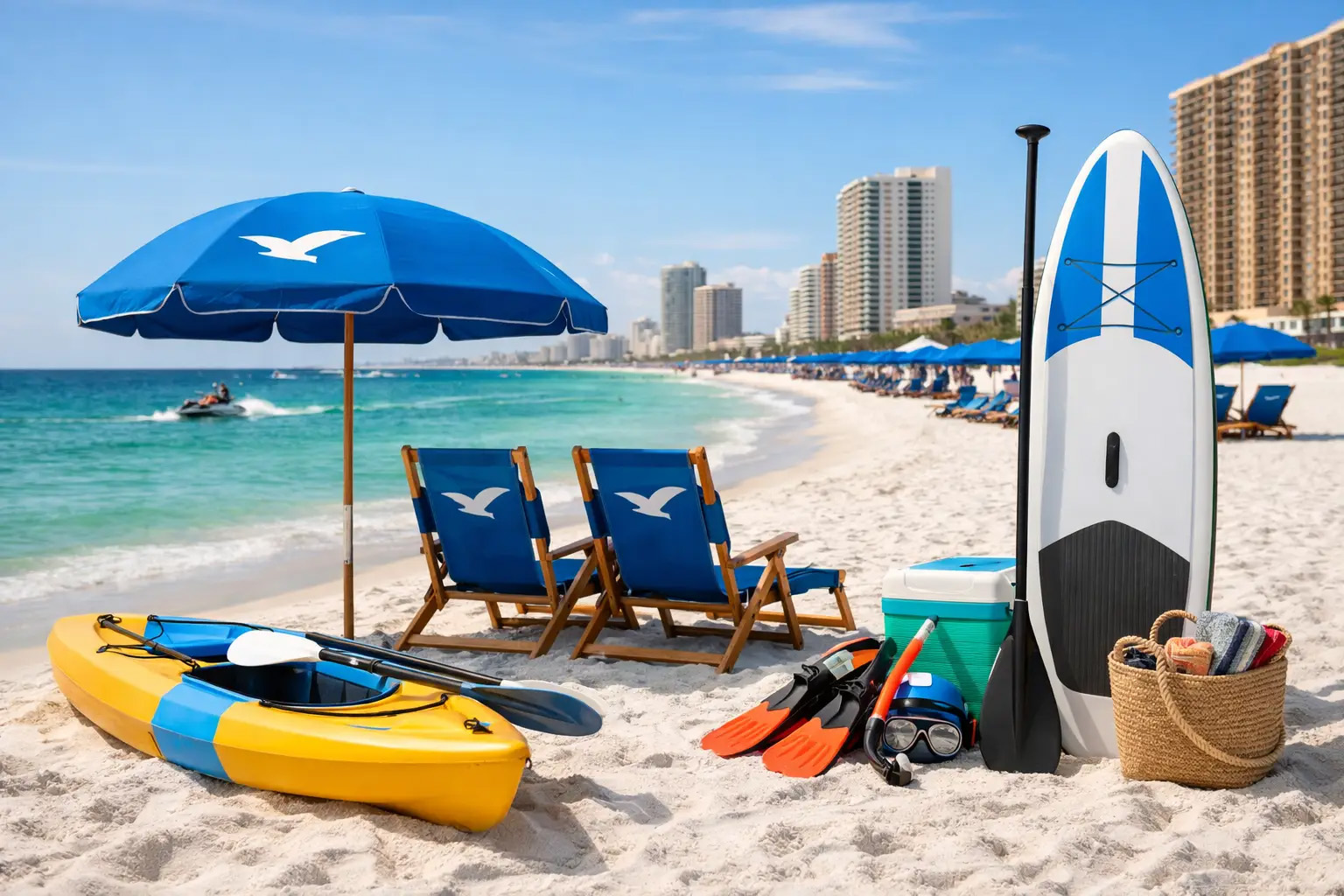
The difference between a relaxed beach day and a frustrating one often comes down to the first hour. Families who arrive with shaded seating, dry towels, cold drinks, and a plan for the kids can settle in quickly. Those who arrive carrying too much or searching for supplies during a busy week can lose valuable vacation time. Renting beach gear in Panama City Beach gives some visitors a practical way to travel lighter while still enjoying the shoreline comfortably.
A rental can solve a real vacation problem, but the right choice depends on your group, your accommodations, and how you plan to use the beach. A couple spending two quiet mornings by the water needs something very different from a family with young children, a cooler full of lunches, and a full afternoon ahead.
Start With Your Beach-Day Plan
Before you reserve anything, decide what a successful beach day looks like for your group. Consider how many people need a seat, how long you expect to stay, whether anyone needs extra shade, and how far you will walk from your vacation rental to the sand. These details help you avoid paying for gear that adds little value or arriving without something you genuinely need.
For many guests, chairs and an umbrella or canopy form the foundation. They create a comfortable home base for reading, resting, watching children near the shoreline, and taking a break from direct sun. If you plan to spend several hours on the beach, shade matters more than you might expect, especially during the warmest part of the day.
Families often benefit from adding a cooler, beach cart, boogie boards, or sand toys. A cart can make a significant difference when your rental is across the street, behind a dune walkover, or several buildings from the beach. On the other hand, guests staying directly on the Gulf may prefer a simpler setup and fewer items to manage.
Know the Difference Between Beach Service and Gear Delivery
Not every beach rental operates the same way. Some providers set up chairs and umbrellas in a designated area of the beach. Others deliver equipment to your vacation rental, where you take it to the sand and return it as directed. Both options can work well, but each requires different planning.
A staffed beach-chair setup at the complex where you are staying offers convenience. You can arrive, check in with the service, find your chairs, and begin your day without carrying equipment. This option often suits guests who want a polished, low-effort beach experience. Availability, location, and daily operating conditions can affect these setups, so confirm the details before you count on a particular row or location. Typically, the guest will be paying for this service but, a few vacation rentals include this service in the price. Be sure to check so there are no surprises. You can usually reserve beach chairs in advance to be sure you will have a place upon arrival.
Delivered gear gives you more flexibility. You may use the equipment at different beach access points or bring it to a quieter stretch of sand. However, delivery rentals place more responsibility on you. Confirm where the provider will leave the items, where you should store them overnight, and when the provider will collect them.
Ask About Access Before You Reserve
Panama City Beach includes a mix of beachfront condominiums, vacation homes, resort properties, and neighborhood access points. Your lodging location affects which gear arrangement makes the most sense. A beach-service provider may work from a particular beachfront area, while a delivered setup may require you to carry items through an access point.
Review your property’s parking, beach access, storage space, and community rules before you reserve larger equipment. Some properties limit where guests can place gear, and they do not offer convenient space for storing bulky items overnight. Panama City Beach operated under a "No Trace Left Behind" ordinance that requires all beach gear be removed from the beach each evening. A quick check protects you from an avoidable inconvenience after check-in.
Reserve Early for Peak Travel Dates
Spring break, summer holidays, long weekends, and major events bring more visitors to the beach. During these periods, popular chair setups, umbrellas, golf carts, bicycles, and family-sized equipment can sell out early. Last-minute rentals may still be available, but you may have fewer choices, less convenient delivery windows, or a higher price.
Reserve as soon as you know your travel dates if particular beach gear is important for your vacation plans. This approach matters most for groups that need several chairs, a large canopy, mobility equipment, or specialty items for children. Confirm the reservation in writing and keep the provider’s contact information available before arrival.
Price deserves attention, but it should not control the entire decision. Compare the rental period, delivery fees, service area, deposit requirements, weather policies, and replacement costs. A lower daily rate can become less attractive if it adds a delivery charge, requires a long pickup trip, or creates a difficult return schedule on your departure day.
Choose Gear That Fits the Weather, Not Just the Photo
A wide umbrella and matching chairs may look ideal in a listing photo, but coastal weather requires practical judgment. Wind can change quickly along the Gulf, and a lightweight setup that works on a calm morning may not suit a breezy afternoon. Ask how the provider handles wind restrictions and whether staff may close or remove umbrellas when conditions become unsafe.
Do not treat rented shade equipment as a substitute for weather awareness. Check the beach flag conditions each day, supervise children near the water, and respond quickly to changing surf or storms. Beach gear should make the day more comfortable, not encourage your group to stay exposed to unsafe conditions.
The same principle applies to water equipment. Boogie boards, paddleboards, kayaks, and similar items can add fun for confident swimmers in suitable conditions. They require more attention than chairs or toys, however. Consider your group’s experience, the day’s surf, and the effort required to transport and supervise the equipment.
Keep Children Comfortable Without Over-packing
Parents often feel tempted to rent every possible item for a beach day. In practice, a focused setup usually works better. Shade, drinking water, sunscreen, snacks, towels, and a few familiar toys cover the essentials for most young children. Add chairs or a wagon if they improve comfort or reduce the number of trips you need to make.
Very young children may need frequent shade breaks, dry clothing, and a quiet place to rest. Plan for those needs before you commit to a long stretch on the sand. A comfortable child makes the entire group’s day easier.
Read the Rental Terms Before Delivery Day
Rental terms deserve more than a quick glance. Confirm the rental start and end dates, expected delivery time, pickup procedure, and instructions for damaged or missing items. If you book a multi-day rental, find out whether the provider expects you to secure the gear overnight or whether they handle daily setup and removal.
Also ask about weather cancellations. Providers vary in how they handle high winds, heavy rain, or beach closures. Some may offer a credit or adjustment under certain circumstances, while others may not. Clear expectations reduce friction if conditions change after you arrive.
Take a few moments to inspect delivered equipment when it arrives. Check chairs, wheels, straps, coolers, and water equipment for visible damage. If anything looks unusable or incomplete, contact the provider promptly. Early communication gives the company a fair chance to correct the issue and documents the condition of the equipment.
Match the Rental to the Rest of Your Vacation
Beach gear should support your plans rather than dictate them. Guests who intend to explore restaurants, attractions, and nearby activities may want a compact, one-day setup. Guests who plan to spend most mornings and afternoons on the sand may receive more value from a multi-day chair and umbrella arrangement.
Think about your departure day as well. If checkout requires an early start, avoid rentals that require a complicated return process or a narrow pickup window. A clear plan lets you enjoy your final morning instead of managing equipment logistics.
The best rental choice rarely involves the most gear. It involves the gear your group will actually use, delivered or set up where you need it, with terms you understand before you arrive. When you make those decisions early, the beach can feel less like a project and more like the reason you came.
Renting Baby Gear in Panama City Beach
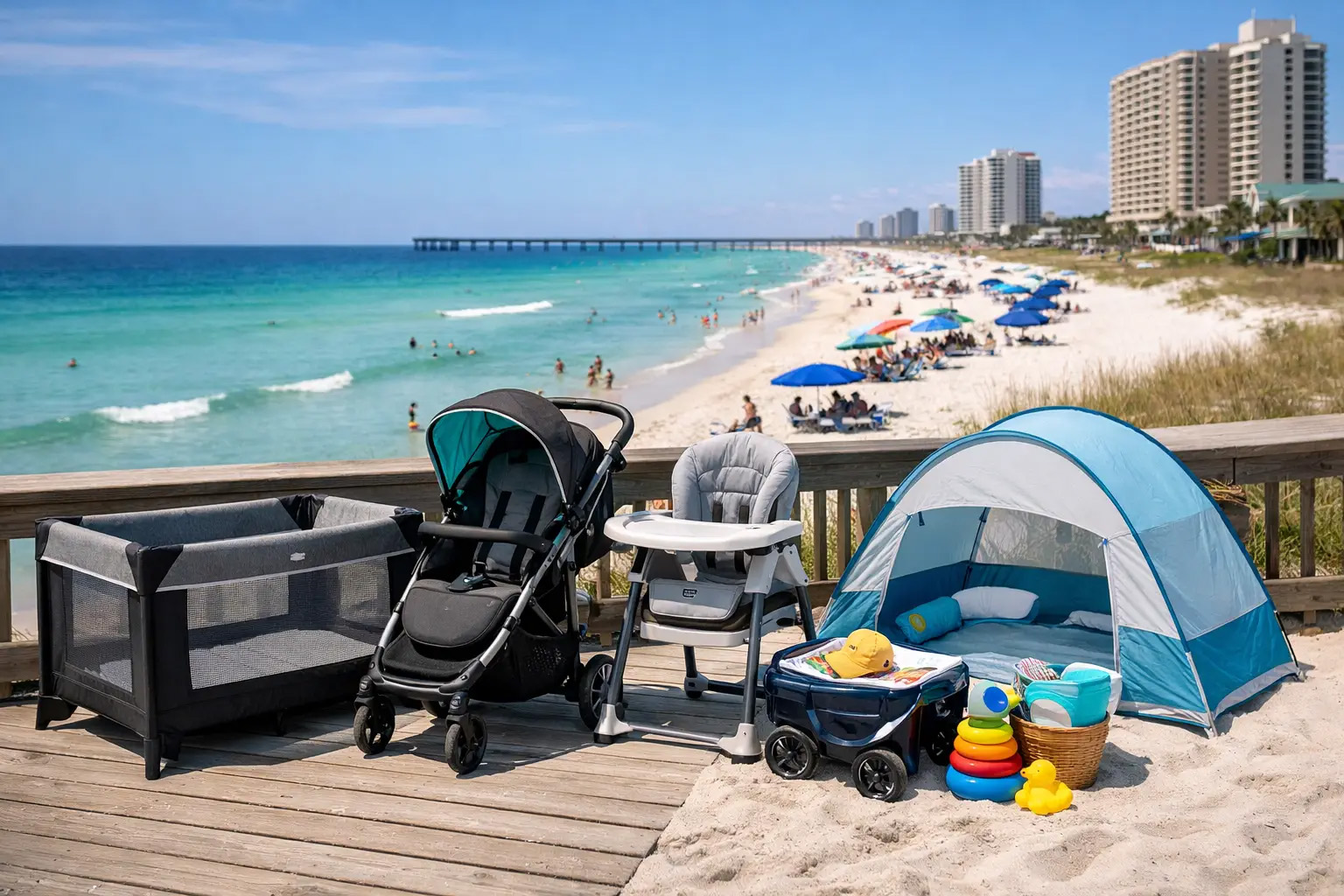
A stroller piled with beach towels, a portable crib, a high chair, and a car seat can turn a family getaway into a complicated packing exercise before the trip even begins. Renting baby gear in Panama City Beach can reduce that load, but families should make decisions based on safety, sleeping needs, transportation plans, and the equipment already available at their vacation rental.
The right approach does not mean renting everything. It means bringing the items your child relies on most, confirming what your accommodations provide, and reserving only the gear that will make the week easier.
Renting Baby Gear in Panama City Beach: Start With Your Stay
Review your vacation rental details before you contact a baby gear provider. Some homes and condos offer a crib, pack-and-play, high chair, or stroller, while others do not. Amenities vary by property, and families should never assume that a listing includes infant equipment simply because it welcomes children.
Ask specific questions before arrival. Confirm the type of sleep space, the high chair style, and whether the property provides linens for a crib or pack-and-play. If you plan to use a stroller, consider the property layout as well. A beachfront high-rise may involve elevators, parking garages, and longer walks to the sand. A beach house may offer more room for gear but include stairs or a sandy walkway.
A quick inventory prevents duplicate rentals and gives you time to plan around your child's routine. For example, a family with a baby who sleeps well in any familiar sleep sack may only need a safe rental crib. A toddler who uses a specific booster seat at every meal may do better with that item packed from home.
Choose Gear Based on the Moments That Matter
Families often rent gear because they picture every possible need. A better plan starts with the parts of the day where equipment solves a real problem.
For sleep, prioritize a safe, age-appropriate crib or pack-and-play with a firm mattress that fits correctly. Babies need a clear sleep space. Do not add pillows, loose blankets, padded inserts, or soft toys to compensate for an unfamiliar room. Bring familiar sleep clothing, such as a sleep sack, when it supports your child's normal routine.
For meals, a full high chair can make sense for a baby who eats several meals a day at the rental. A compact booster may work better for an older toddler, particularly in a condo with limited dining space. If your child has food allergies, pack or purchase the cleaning supplies and familiar utensils you need rather than relying on equipment you have not inspected.
For outings, think beyond the beach. A stroller helps with evening walks, visits to Pier Park, and trips from a parking area to the shoreline. However, a lightweight umbrella stroller may struggle in deep sand. A wagon or all-terrain stroller can handle beach access more effectively, but it takes up more space and may not fit easily in every elevator, vehicle, or rental entryway.
For the beach itself, a shaded play space, portable fan, or beach cart may help during long afternoons. These items offer convenience, not necessities. Panama City Beach sun and heat require closer supervision than any piece of gear can provide. Plan beach time around naps, bring water for adults and older children, and use shade and protective clothing as part of a practical sun plan.
Treat Safety Checks as Non-Negotiable
A rental provider should be able to explain how it cleans, inspects, and maintains each item. Ask when the company last checked the equipment, whether it follows manufacturer instructions, and how it handles product recalls. A provider that cannot answer basic questions about condition and cleaning does not deserve your business.
Inspect every item when it arrives. Check for cracked plastic, loose screws, frayed straps, missing hardware, sharp edges, and unstable legs. Test brakes on strollers and wheels on cribs or play yards. Confirm that a high chair restraint works and that the tray locks securely. If anything looks damaged, incomplete, or poorly cleaned, request a replacement before you use it.
Car seats require an even higher standard. Many parents prefer to bring their own car seat because they know its history, fit, and expiration date. If you rent one, make sure the provider can confirm that the seat has never been in a crash, has not expired, includes all required parts and labels, and comes with the manufacturer's instructions. Install it carefully in the vehicle you will use, and do not accept a seat that you cannot install correctly.
Families should also avoid using older hand-me-down equipment supplied informally by a host, friend, or neighbor unless they can verify its condition and current safety status. Product standards change. A familiar-looking item may no longer meet current guidance.
Reserve Early, Then Confirm the Details
Baby gear inventory can tighten during peak travel weeks, especially when several families arrive on the same Saturday. Reserve essential items as soon as you finalize your accommodations and travel dates. Cribs, full-size strollers, and beach wagons often require more advance planning than small accessories.
Before you reserve, confirm the total cost, delivery area, delivery window, pickup timing, damage policy, and cancellation terms. Ask whether the company delivers inside the rental, leaves items at the door, or requires an adult to meet the driver. That detail matters when your check-in schedule includes grocery shopping, flight delays, or a tired child who needs bedtime immediately.
Measure when size matters. A full-size crib may not fit comfortably in a small bedroom, and a large stroller may create an obstacle in a narrow condo entry. If you rent a multi-level home, ask whether the provider offers gates or whether you should bring your own portable safety solutions. Do not improvise with unsuitable barriers around stairs, pools, balconies, or doors.
Pack the Items That Are Hard to Replace
Rental gear works best when it takes care of needs for bulky equipment. Bring the personal items that support comfort, hygiene, and medical needs. A favorite sleep sack, pacifier, baby monitor, bottles, formula supplies, medications, and prescription items belong in your travel plan, not in a last-minute search after arrival.
Keep a small first-day bag with diapers, wipes, a change of clothes, feeding basics, and bedtime essentials. Delivery schedules can shift, check-in may run late, and a child does not adjust their needs to a vacation timetable. This bag gives your family a calm first evening even if the rest of your groceries or gear arrives later.
You may also want to pack a compact carrier. A carrier does not replace a stroller, but it can make a boardwalk walk, restaurant wait, or airport transfer much easier. It also gives parents an option when sand makes wheels impractical.
Match the Plan to Your Child, Not the Packing List
An infant, a newly mobile baby, and a preschooler create very different travel needs. A family traveling with an infant may value a dependable sleep setup above all else. Parents of a toddler may care more about a high chair, stroller, and childproofing around a new space. Families with older children may need little more than a booster and a way to transport beach supplies.
Length of stay also changes the calculation. For a long beach vacation, a quality stroller and high chair may earn their cost every day. For a two-night visit, bringing a few compact essentials may cost less and reduce coordination. Consider how often you will use each item, not just whether it sounds useful.
The goal is not to recreate every corner of home. It is to create a safe, manageable vacation environment where parents can spend less time hauling equipment and more time enjoying the shoreline, poolside breaks, and unhurried family dinners. Reserve the gear that supports that plan, inspect it carefully, and leave room in the car and the schedule for the moments you came to enjoy.
Can Vacation Rentals Fit Large Families?

A large family trip usually breaks down in the same places - sleeping arrangements, bathroom traffic, parking, and the question nobody asks soon enough: will everyone actually be comfortable for the entire trip? That is why many travelers ask, can vacation rentals fit large families comfortably? In many cases, yes. But the real answer depends on your family group, the layout and not just the advertised guest count.
A property that sleeps twelve on paper may feel tight for eight in practice. Another home with a smart floor plan, enough bathrooms, and usable common space can handle grandparents, cousins, and kids without turning into a bottleneck. Families do best when they look past the headline number and evaluate how the property might work for their group on a day to day basis.
Can vacation rentals fit large families in real life?
They can, and almost always better than standard hotel setups. A hotel may split a family across multiple rooms and floors, which creates more coordination, less privacy for parents, and fewer shared spaces. A well-managed vacation rental gives the group one place to gather, cook, rest, and keep a predictable routine.
That advantage matters more when the trip includes multiple generations. Grandparents may need a first-floor bedroom or fewer stairs. Parents may want a separate living area after the kids go to bed. Teenagers usually need personal space more than anyone else. Vacation rentals can meet those needs, but only if the property offers real separation between sleeping zones and enough room for people to spread out.
This is where families often make the wrong call. They assume bedroom count tells the whole story. It does not. Four bedrooms can work beautifully for a larger group if the home includes bunk space for children, a sleeper sofa in a second living room, and three or more bathrooms. A six-bedroom property can still feel inefficient if two bedrooms are tiny, one is a pass-through, and the kitchen cannot support a group meal.
What large families should check before booking
Start with the sleeping plan. Do not stop at the phrase sleeps 10 or sleeps 14. Read the actual bed mix. Two king beds, one queen, and four twin bunks fit a different group than five queen beds. Families with small children may welcome bunk rooms. Adult siblings with spouses usually will not. If the group includes older relatives, confirm bed height, stair access, and whether anyone must walk through another bedroom to reach a bathroom.
Bathrooms matter almost as much as bedrooms. A large family can work around tighter sleeping arrangements for a few nights, but too few bathrooms creates stress fast. Three bathrooms for ten guests may work if one serves a bunk room and another connects to the main suite. Two bathrooms for ten guests usually means lines, rushed showers, and can create frustration before anyone reaches the beach or is ready for dinner.
Common areas deserve the same scrutiny. Look for seating that matches the group size, a dining table that can handle shared meals, and a kitchen that supports more than one person cooking. Many listings show a beautiful open room, but the details tell the truth. If the living room seats five and the home sleeps twelve, part of the group will always feel displaced.
Parking also gets overlooked. Large families often arrive in several vehicles. A property that technically fits the group indoors may still become difficult if parking is limited or strict. The same goes for elevators, beach access, and entry stairs. Convenience does not sound critical during booking, but it affects every day of the stay.
Space matters more than headcount
The best vacation rental for a large family is not always the one with the highest occupancy. It is the one that balances private space and shared space. Families need room to be together, but they also need relief from each other.
That balance often comes from the floor plan. Homes with split bedroom layouts, multiple living spaces, or a quiet sitting area tend to perform better for bigger groups. So do properties with outdoor areas where part of the family can gather while others rest inside. Balconies, patios, and easy beach access create breathing room, which helps everyone enjoy the trip.
In beach markets such as Panama City Beach, this point becomes even more practical. Families usually spend part of the day in and out with towels, coolers, sand, and changing schedules. A cramped entry, one small fridge, or limited storage can turn a good-looking property into a frustrating one. On the other hand, a rental near the beach with strong indoor-outdoor flow and enough room for gear often feels easier than a larger property with an awkward layout.
The trade-offs families should expect
Large-family rentals come with trade-offs, and experienced travelers plan for them early. The first trade-off is budget. A bigger home may cost more upfront, but multiple hotel rooms add up quickly, especially once parking, resort fees, and eating every meal out enter the picture. For many groups, a vacation rental creates better total value even if the nightly rate looks higher at first glance.
The second trade-off is privacy. Sharing a home gives families more connection, but less separation than completely independent hotel rooms. Some groups love that. Others need clearer boundaries. If your family includes early risers, toddlers, night owls, or relatives who prefer quiet, choose a property with doors, zones, and enough distance between bedrooms.
The third trade-off is availability. Large-family properties book earlier because the inventory is smaller. Families who need a specific week, a certain bedroom mix, or beach proximity should plan ahead. Waiting limits options and often forces compromises on layout or location.
How to tell if a rental will actually work for your group
The most reliable approach is to build your group plan before you shop. Count adults, children, couples, and anyone with mobility concerns. Decide who can share a room and who cannot. Think through mornings, not just nights. Where will coffee happen? Who needs a quiet nap space? Will children go to bed before adults finish dinner? These answers reveal what the property must provide.
Next, match the home to your routines. A family that cooks breakfast and dinner every day should prioritize kitchen space, dining capacity, and grocery storage. A group that plans to stay on the beach most of the time may care more about outdoor showers, laundry, and location. If the trip includes grandparents and young kids, easy access often matters more than luxury finishes.
Photos help, but they do not answer everything. Read descriptions carefully and look for specifics. Good property management companies describe bed types, bathroom counts, parking, beach access, and occupancy rules with precision. That level of detail usually reflects stronger operations overall. Emerald Beach Properties, for example, serves guests best when expectations stay clear from the start. That clarity helps families avoid mismatches that can affect the entire trip.
When vacation rentals are a strong fit for large families
Vacation rentals usually work best for families who want shared time without constant logistics. They make sense when the group values eating together, keeping children close, and having one home base near the beach. They also work well for milestone trips - reunions, birthdays, anniversaries, and school-break vacations where people want more than a place to sleep.
They may be less ideal for families who want maximum separation, highly flexible arrival patterns, or full-service hotel amenities. That does not mean a rental cannot work. It means the group should be honest about expectations. The right answer depends on how your family travels.
There are many vacation rentals managed by Emerald Beach Properties that are in the same complex as others so, choosing to split your group into two, three or more properties may work best for you. For example, for a really large group, you may choose to rent a large 3-4 bedroom condo and additional 1 or 2 bedroom units for the members of the party who would like more privacy. That way, you can have one large kitchen for group meals and plenty of bathrooms and bedrooms, too. Call us at (850) 234-0997 and we can assist you with planning your trip and choosing your best options for vacation rentals.
For many larger groups, the best stay comes from choosing a property that feels slightly bigger than the minimum requirement. A little extra room changes the tone of the trip. It gives children space to play, adults space to talk, and everyone a better chance to relax.
If your group is asking whether vacation rentals can handle a large family, the answer is definitely yes - when you evaluate the property as a living space, not just a listing. Count bathrooms as carefully as beds. Study the layout. Think about mornings, parking, meals, and downtime. When the home fits the way your family actually moves, the trip feels easier from day one.
Vacation Rental Tech for Our Guests and Owners

A late check-in after a long drive to the beach can either feel simple or frustrating. The difference often comes down to systems that work the first time. Vacation rental tech for our guests and owners is not about adding gadgets for appearance. It is about simplifying the process, protecting property, and giving both sides of the rental experience more confidence.
For guests, the best technology removes small points of stress before they turn into bigger problems. In a market where timing, turnover, and trust matter, technology should support guest satisfaction.
What vacation rental tech for our guests and owners should actually do
Good vacation rental technology serves a clear operational purpose. It should make arrival easier, communication faster, property access more secure, and maintenance more manageable. If a system creates more confusion than clarity, it does not help anyone.
Guests care about practical outcomes. They want clear check-in instructions, fast answers, reliable Wi-Fi, and a property that matches expectations. For property managers, there are also practical consideration. They need to know who entered the property, whether housekeeping finished on time, how issues were documented, and how quickly the team addressed problems.
That overlap matters. The same platform that gives a guest a timely arrival message can also give the property manager confidence that procedures happened on schedule. The same smart lock that helps a family avoid a key pickup can also create a controlled access record for the property manager.
Smart access sets the tone
Access technology often shapes the first impression of a stay. A lockbox with a worn code, a missing key, or unclear directions creates stress before the guest even opens the door. Smart locks and controlled entry systems solve a real problem when they are managed correctly. At Emerald Beach Properties, we use high tech internet connected lock systems in all of our properties.
The value goes beyond convenience. Time-sensitive entry codes reduce the risk that an old key or shared code remains active after departure. They also support cleaner turnover procedures because housekeeping and maintenance teams can receive limited access that matches their assigned schedule.
That said, smart access still requires discipline. Battery checks, backup entry plans, and tested code delivery matter. Technology does not remove responsibility. It increases the need for strong operating procedures. A good system includes redundancy, because guests do not care whether the issue was software, hardware, or human error. They care whether they can get inside. This is the reason for having our office phone number on each door and a back up key boxes located at each door we manage.
Messaging systems matter more than most people think
Most guest questions follow a predictable pattern. They ask about check-in time, parking, Wi-Fi, beach access, gate codes, or what to do if something stops working. A strong messaging system gives clear answers at the right time without forcing guests to chase down basic information.
Automated communication helps, but only when it feels intentional. Scheduled arrival messages, departure instructions, and mid-stay check-ins can keep the stay organized. But too many messages create noise. Too few create uncertainty. The right balance depends on the property, the season, and the kind of traveler.
Owners benefit here too. Centralized messaging creates a record of what was sent, when it was sent, and how the guest responded. That record matters when questions come up about service quality or expectations. It also helps management teams spot repeat issues across properties instead of treating every complaint as a one-off event.
Connected property systems protect the home
Technology inside the home should support protection and performance. Smart thermostats, water sensors, noise monitoring tools, and device alerts can help catch problems early. In a vacation rental, early detection has real value.
A water leak that runs for hours between stays can damage flooring, drywall, and owner revenue. A thermostat set too low in summer can strain equipment or cause condensation that may create a moldy situation. A noise alert can help a manager respond before a disturbance becomes a neighborhood issue. These systems help teams act sooner, not later.
There are trade-offs. Too much monitoring can feel intrusive if it is not handled properly. Guests expect privacy, as well they should. That means any technology used at a property must respect legal standards, be disclosed where appropriate, and focus on legitimate operational needs rather than overreach. Good management uses technology to protect the property without crossing that line. Emerald Beach Properties does not allow any camera monitoring inside our units.
The best guest experience still depends on human follow-through
Technology can speed up communication and organize service, but it cannot replace judgment. If the air conditioning stops during a hot week or a door code fails after dark, the guest needs a real solution. Systems help route the issue to the people who can solve it.
In a beach market, where turnover is fast and guest expectations are high, responsiveness matters. The strongest operation uses technology to support trained staff, documented processes, and direct accountability. That combination protects the guest experience and the owner relationship.
Vacation rental tech for our guests and owners also improves turnover
The period between checkout and check-in is where many operational failures begin. Housekeeping delays, missing inventory, maintenance surprises, and inspection gaps all affect the next arrival. Good technology helps teams coordinate that narrow window with more precision.
Digital cleaning checklists, time-stamped inspections, photo verification, and maintenance tracking create a clearer operational record. Property managers do not need every detail in real time, but they do need confidence that someone verified the condition of the property before the next guest arrived.
This is where tech becomes practical rather than promotional. It helps management teams document work, escalate issues, and keep standards consistent across busy schedules. It also helps identify patterns. If the same appliance causes repeat calls or the same unit regularly needs extra cleaning time, the data points to a fix.
Security is not a side feature
In vacation rentals, security applies to both the physical property and the information that supports the booking. Guest data, owner records, access credentials, payment workflows, and internal systems all require protection. That is not a background issue. It is central to trust.
A professional operation treats system access, user permissions, monitoring, and data handling with care. Guests may not ask about those controls directly, but they notice the effect. They see it in reliable booking workflows, verified communication, and fewer avoidable errors. Owners notice it in cleaner oversight and stronger control over who can access property information.
Security-forward management also means knowing where convenience should stop. Not every shortcut is worth taking. A faster process that weakens access control or creates confusion does not improve the experience. It creates risk.
What owners and guests should expect from a modern operation
The right technology should feel quiet when it works well. Guests should receive the information they need without having to chase it down. Staff should know what happens next, who handled it, and where an issue stands.
That does not mean every property needs every device or every platform. A smaller condo and a large beachfront home may need different solutions. A family-focused rental may prioritize simple access and communication, while a high-demand property may benefit from more detailed monitoring and turnover controls. Good decisions depend on the property, the guest profile, and the management standard behind the tools.
At Emerald Beach Properties, that standard matters. Technology should support reliable stays, protected homes, and accountable management. It should not distract from service or replace it.
The best test is simple. If a tool helps guests arrive with less stress and helps owners operate with more confidence, it earns its place.
Comparison Shopping for Your Vacation Rental

A vacation rental that looks like a bargain at first glance can end up costing more than another property that you almost skipped. That usually happens when travelers focus on the nightly rate and ignore the rest of the total. If you want to know how to compare vacation rental fees the right way, you need to look past the headline price and evaluate the full cost of the stay.
That sounds simple, but fee structures vary from one property to the next. One home may carry a higher nightly rate with modest add-on charges. Another may advertise a lower base rate and make up the difference through cleaning fees, service fees, parking charges, or damage waivers. The only useful comparison is the final total you will pay for the rental.
If you are using AirBnb, VRBO or other online platforms to book your vacation rental, you will pay more than if you book direct with the local vacation rental manager. These platforms typically mark up their reservations on top of the local manager rates by as much as 15-20%. If you want to see the difference, visit Emerald Beach Properties website and our price comparison tool will show you the difference when you are pricing a property.
Start with the total, not the nightly rate
The nightly rate is only one part of the cost. It matters, but it does not tell you what you will actually pay. The total booking amount gives you a more accurate picture because it includes the charges that affect your budget in real terms.
When you compare two vacation rentals, pull the total for the same dates, same number of guests, and same general booking terms. If one quote reflects a three-night stay and the other reflects four nights, your comparison breaks down immediately. The same issue applies if one property includes taxes and another shows them later in the checkout flow.
A clean comparison starts with matching conditions. Same travel window. Same occupancy. Same payment structure. Then you can judge value with confidence.
Which fees matter most
Some fees are standard and reasonable. Others deserve a closer look. The point is not to avoid every fee. The point is to understand what each one covers and whether it fits the property, the stay length, and the service level.
Cleaning fees
Cleaning fees often create the strongest reaction because they are charged in addition to the nightly rate and will be larger on shorter stays because the charge is per reservation, not by the number of days you stay. But they are not automatically excessive. A professionally managed vacation rental requires a full turnover process between guests, including laundry, sanitation, inspection, restocking, and scheduling. That work costs money whether you stay two nights or seven.
This is where length of stay matters. A $250 cleaning fee may feel steep on a weekend trip, but it becomes less significant over a full week. Divide the cleaning fee across the number of nights to see its actual impact per night.
Service or booking fees
Service fees can vary widely depending on the booking channel or management structure. They support payment processing, reservation support, fraud controls, and guest communication.
If the listing does not explain the fee, that is a valid reason to ask. A professional manager should be able to tell you what you are paying for.
Taxes
Taxes are not optional, and they should never surprise you at the last minute. Local and state lodging taxes can add a meaningful amount to the total. Make sure each quote includes the same tax treatment before you compare one property to another.
In the Panama City Beach market, if you are staying inside the city limits of PCB, there is an additional 1% tax that must be paid. If you are staying in the county outside the city, this fee is not paid.
Damage waivers or security deposits
Some rentals require a refundable security deposit. Others use a nonrefundable damage waiver. Neither option is inherently better. A refundable deposit may cost more upfront but come back to you later if there are no issues. A damage waiver usually costs less at booking but does not return to you.
Emerald Beach Properties uses a nonrefundable damage waiver. One advantage to this system is that we do not have to charge guests credit cards for a damage deposit and then return it later. Also, damages are covered as long as they are reported during your stay.
The right choice depends on who you are booking with and the options they offer, your comfort level & cash flow.
Parking, resort, and amenity fees
These charges matter most in every market and resort-style buildings. Parking, gate access, wristbands, pool & facilities access, security, and building registration fees will affect the final price. In Panama City Beach, for example, location and building rules these fees vary by complex and they are not included in the nightly rate. These fees are typically charged by reservation and not by how many nights you stay.
That does not make the fees unreasonable. It means you should account for them early, especially if you are comparing a beachfront condos in different complexes.
How to compare vacation rental fees accurately
The most reliable method is to reduce each option to a true per-night cost, then judge what you receive for that amount.
Take the full booking total, including mandatory fees and taxes, and divide it by the number of nights. That gives you an effective nightly cost. Once you have that number for each property, the comparison becomes clearer.
Then look at what is included. Does one rental sit directly on the beach while the other requires a drive and paid parking? Does one include beach service, in-unit laundry, or access to multiple pools and other resort amenities? Does one offer stronger guest support or a more flexible cancellation policy? A lower effective nightly cost is helpful, but not if it comes with trade-offs that matter to your trip.
This is where travelers sometimes make the wrong call. They compare totals without comparing all the factors that you are looking for in a vacation rental. A family with young children may save money overall by booking the property with easier beach access, an elevator, and a full kitchen, even if the fee line items look higher at first.
Watch for fee timing and payment structure
Not every charge appears at the same moment in the booking process. Some properties show all mandatory fees upfront. Others reveal portions of the total later. That difference can distort your decision if you move too quickly.
Review the booking screen carefully before payment. Look for charges due at booking versus charges due at check-in. Also confirm whether any fees are conditional. Pet fees, extra guest charges, and late check-out fees may not apply to every stay, but they should still factor into your comparison if they apply to yours.
Red flags when comparing fees
A professional vacation rental business should present pricing clearly and answer direct questions directly. If the fee structure feels vague, inconsistent, or incomplete, treat that as a warning sign.
Be cautious when the total changes unexpectedly from one screen to the next, when mandatory fees lack a description, or when the property manager cannot explain a charge in plain terms. You should also pause if the listing advertises an unusually low nightly rate that does not align with similar properties in the same area. That often signals that the real cost sits somewhere else in the booking flow.
Transparency matters because it reflects operations. Clear pricing usually comes from a disciplined management process. That benefits guests before arrival and during the stay.
Compare value, not just cost
The strongest booking decision balances price, location, condition, and management quality. Fees are part of that decision, not the whole decision.
A well-managed property may charge a higher cleaning fee because it maintains higher housekeeping standards. A building with parking or amenity fees may offer direct beach access, security, and better-maintained common areas.
That does not mean every fee is justified. It means you should ask whether the cost matches the experience. If it does, the higher total may still be the smarter choice.
For travelers booking in a beach market, that distinction matters. Location can change the shape of your stay. Being steps from the sand instead of several blocks away may reduce parking costs, simplify your day, and improve the trip enough to outweigh a modest difference in fees.
A simple way to make the final call
If you are deciding between two or three rentals, build a side-by-side comparison with five numbers: nightly rate, mandatory fees, taxes, total cost, and effective nightly cost. Then add a short note about what each property includes and what trade-offs come with it.
That process removes emotion from the first impression. It also helps you avoid the common mistake of overvaluing a low advertised rate.
Emerald Beach Properties serves guests who want that kind of clarity because vacations run better when expectations match the booking. Good pricing should hold up under scrutiny. When a rental fee structure is clear, consistent, and easy to verify, you can focus less on fine print and more on choosing the property that fits your trip.
Beach Safety in PCB: What Visitors Need To Know

A calm Gulf morning can turn risky faster than you might think. That is why beach safety deserves more than a quick glance at the water from your balcony. Conditions change by the hour, and a beach day goes better when you treat the shoreline with the same respect you give the sun, traffic, or any other vacation activity.
Panama City Beach gives families long stretches of sand, warm water, and clear views that make it easy to relax. That same setting can create false confidence. Gentle-looking surf can still hide a strong current, and bright weather does not guarantee safe swimming. The best approach is simple - check conditions early, stay alert, and make decisions that match the weakest swimmer in your group, not the strongest.
Beach safety in PCB starts before you reach the sand
Most beach problems begin with assumptions. Guests assume the water will stay as calm as it looked at breakfast. Parents assume children will remain in the same area. Strong swimmers assume they can handle rough surf because they swim well in a pool. Those assumptions can create avoidable risk.
Start your day by checking the beach flag status and the weather. In PCB, flags are not decoration. The flag conditions are posted in every vacation rental managed by Emerald Beach Properties. Check the postings and be aware of what the different colored flags mean. They communicate current water conditions and should drive your plan for the day. If the flags indicate dangerous surf, change the activity. Walk the shore, build sandcastles, or use the pool. A vacation schedule should never overrule beach conditions.
It also helps to set expectations before anyone carries a chair onto the sand. Choose a meeting point. Decide who watches younger children at all times. Put phones in a place where adults can reach them quickly. Small systems prevent confusion when the beach gets crowded.
Understanding the flag system and what it means for your group
The flag system gives you the fastest read on water risk. Many visitors know the colors in general terms but do not always apply them correctly.
A green flag signals calmer conditions, not zero risk. You still need to watch children, assess wave action, and stay aware of drop-offs and fatigue. A yellow flag means moderate hazard. That usually calls for tighter supervision, shallower play, and a more conservative mindset. A red flag means high hazard. Swimming becomes a poor choice for most visitors, especially children, older adults, and anyone without open-water experience. Double red means the water is closed to the public. At that point, the decision is already made for you.
Purple flags warn about dangerous marine life. That does not always mean you need to leave the beach, but you should adjust behavior to avoid contact with marine pests such as jelly fish. Shuffle your feet in shallow water when appropriate, keep a closer eye on children, and avoid casual wading if jellyfish or other hazards are active.
The trade-off is straightforward. Some visitors see a yellow or red flag and feel frustrated because they planned a full water day. The safer choice may feel inconvenient, but it protects the trip. A single injury or rescue can end a vacation much faster than a changed itinerary.
Rip currents are the risk many visitors underestimate
If there is one hazard that deserves serious attention, it is the rip current. In PCB, rip currents can form even when the beach looks calm from shore. They do not always appear dramatic. Often, they look like a calmer, darker, or choppier section of water between breaking waves.
People get into trouble when they fight the current trying to swim directly back to shore. That burns energy fast. If a rip current pulls you away from the beach, stay as calm as possible, float if needed, and swim parallel to the shoreline until you move out of the current. Then angle back toward shore. If you cannot make progress, signal for help and keep conserving energy.
For families, the more practical point is prevention. Stay near lifeguards when available. Keep weaker swimmers in shallow water. Do not use inflatables as a substitute for swimming ability or adult supervision. Wind and current can move floats farther and faster than many people expect.
Who needs the closest supervision
Every beach group has different risk levels, and strong planning helps keep your entire group safe. Young children need constant, active supervision near the waterline, not periodic check-ins from a chair. One adult should watch the child, and that adult should not split attention with a phone, a conversation, or a cooler setup.
Teenagers often create a different challenge. They may look capable and want independence, but they also take more chances in surf. Set clear boundaries for how far they can go and what flag conditions end water activity.
Older adults and guests with medical conditions need their own plan. Heat, fatigue, uneven sand, medication effects, and changing surf can combine quickly. That does not mean they should avoid the beach. It means they should use easier access points, limit time in direct sun, hydrate early, and avoid entering rough water.
Visitors who are confident pool swimmers also need a reality check. Open water demands different judgment. Waves, current, uneven bottoms, and reduced footing change everything you thought you knew about swimming.
Sun, heat, and hydration are safety issues too
Not every beach emergency starts in the surf. In Florida, heat and sun exposure put plenty of visitors in trouble before they ever reach knee-deep water.
Build your day around protection, not recovery. Apply broad-spectrum sunscreen before you head out, and reapply it on schedule, especially after swimming or sweating. Use shade intentionally. A beach umbrella helps, but it does not replace sunscreen or hydration. Drink water consistently through the day, not only when someone says they feel thirsty.
Children often ignore early signs of overheating because they are busy. Adults do the same because they do not want to stop the fun. Watch for flushing, headache, dizziness, unusual fatigue, nausea, or irritability. Those signs deserve action right away. Move into shade, cool down, and hydrate.
The same rule applies to alcohol. A drink on the beach may feel harmless, but alcohol lowers judgment and increases dehydration. That matters more when surf conditions already require caution.
Set up your beach spot with safety in mind
Where you place your chairs matters more than most people think. Choose a spot that gives you a clear line of sight to everyone in your group. Avoid setting up so far from the main activity area that supervision becomes reactive instead of active.
Pay attention to access points and posted notices. Use established walkways rather than climbing over dunes. If there are mobi-mats available, they are the best way to access and leave the sandy beach. Dunes protect the coastline, and damaged dunes create long-term problems for the beach environment. Operational discipline matters here too. Respect the posted rules because they exist for safety, preservation, and access control.
Keep the area organized. Shoes, toys, bags, and coolers scattered across the sand create tripping hazards when people move quickly. If a child bolts toward the water or someone needs help, a cluttered setup slows response time.
Weather changes require fast decisions
Storm risk is one of the easiest hazards to dismiss and one of the most common reasons a beach day should end early. In coastal weather, conditions can shift quickly. Darkening clouds, rising wind, distant thunder, or a sudden drop in beach activity are all cues that it's probably time to pack your gear and head back to the vacation rental.
Do not wait for rain to start before you leave. Lightning can strike well ahead of a storm cell. When thunder is audible, the beach is no longer a safe place to stay exposed.
Wind also changes water conditions, even when the sky still looks inviting. Stronger onshore wind can increase surf and make inflatables harder to control. That is often the moment when families should leave the water, even if they planned to stay another hour.
A safer beach day usually feels less dramatic
The best beach days rarely involve last-second decisions or avoidable rescues. They come from steady judgment. Check the flags. Watch the water. Respect changing conditions. Keep your group close, hydrated, and realistic about their swimming ability.
That mindset protects more than a single afternoon. It gives your family room to enjoy the shoreline with confidence, and it helps every part of the trip run better. When you treat the beach with respect, the experience stays what it should be - memorable for the right reasons.