

Beach Accessibility: Mobi-Mats and Beyond
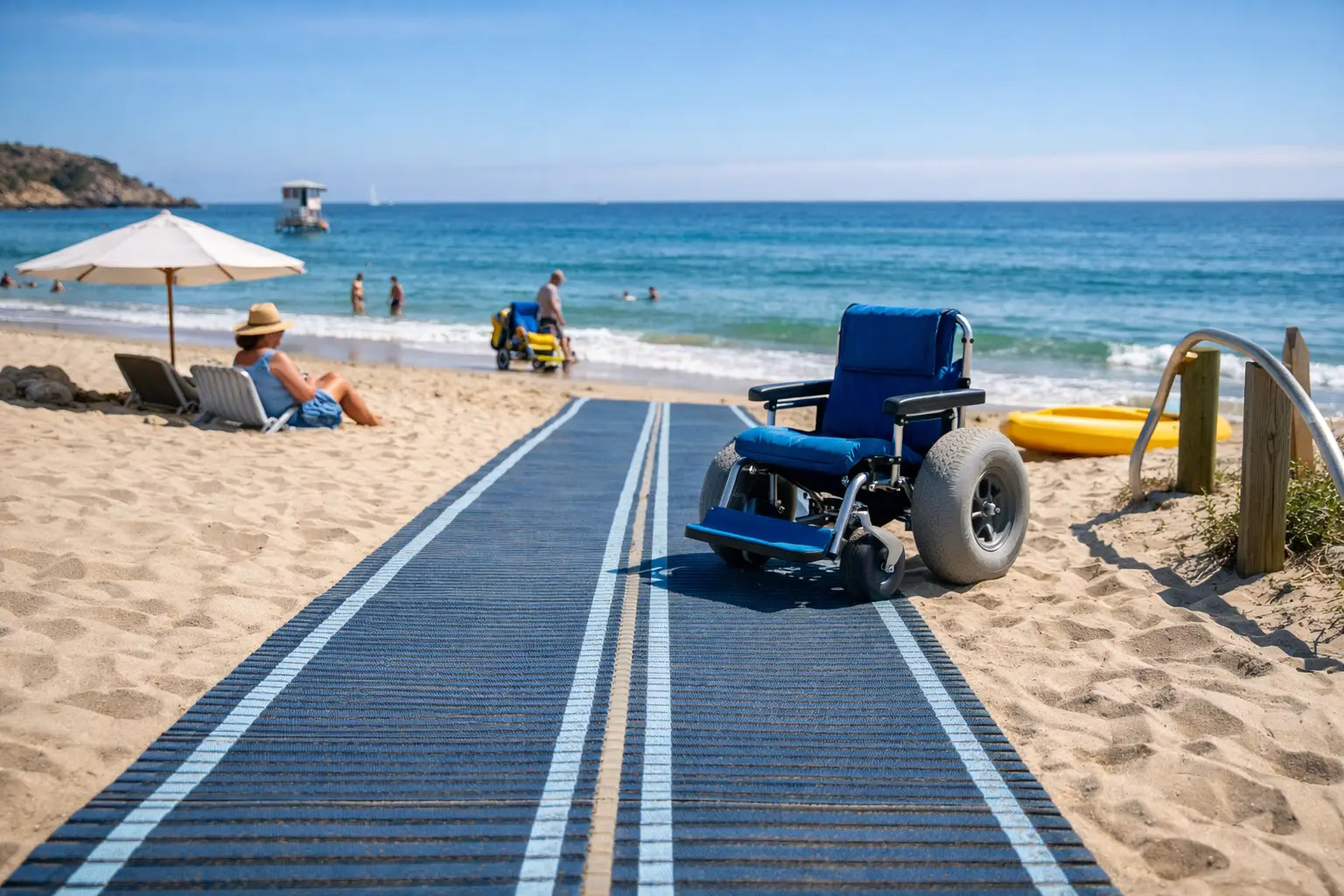
A beach day can fall apart before it starts if the only path to the shoreline is deep, loose sand. For families pushing strollers, guests using wheelchairs, older adults with limited mobility, or anyone recovering from an injury, beach accessibility aids such as mobi-mats and other accessibility aids are an important part of making your vacation more enjoyable. It is When these aids are available at your resort destination, it can make the difference between reaching the water and stopping at the dunes.
For vacation guests, access shapes the entire stay. For property managers, owners, and coastal communities, it affects guest satisfaction, safety, and whether a destination serves people well in practice instead of only in marketing. Mobi-Mats are one of the most visible tools in that effort, and they are widely available in Panama City Beach Resorts.
What Mobi-Mats actually solve
Mobi-Mats are roll-out pathways designed to create a firmer, more stable surface over sand. They make it easier to move wheelchairs, walkers, carts, and strollers across terrain that would otherwise be difficult or impossible for many people to cross independently in deep loose sand.
That matters because the barrier at most beaches is not the parking lot. It is the transition from a hard surface to soft sand. A guest may be able to arrive, unload, and check in without trouble, then find that the final 100 feet to the beach is the hardest part of the day.
A well-placed mat reduces sink, drag, and fatigue. It can also improve confidence. Many guests are less concerned with speed than with predictability. They want to know whether they can move forward safely, whether they will need help, and whether the route feels manageable.
In practical terms, Mobi-Mats work best when they connect a complete route. A mat that begins near a beach entrance but does not tie into accessible parking, a curb cut, or a stable sidewalk or boardwalk solves only part of the problem. Access is cumulative. One weak link can make the entire route more difficult to navigate.
Beach accessibility: Mobi-Mats and beyond the path
The phrase beach accessibility: Mobi-Mats and beyond matters because mats are not the same thing as full accessibility. They improve horizontal travel over sand, but they do not address every barrier a guest may face before, during, or after reaching the shoreline.
For example, a guest with mobility issues will likely need an accessible restroom near the beach access point, not several blocks away. They may need a ramp with manageable slope, handrails in the right places, and parking that is both designated and realistically close. They may also need clear information before arrival, including whether a mat is seasonal, how far it extends, and whether a beach wheelchair is available.
This is where expectations often break down. Beach destinations sometimes advertise access in broad terms, while the actual experience depends on details. Does the mat reach far enough toward the firm sand? Is it maintained? Does it stay in place after weather events? Is there a step, lip, or washed-out section at the entrance? Those are operational questions, but they are what guests remember. Working with a professional local property manager like Emerald Beach Properties, you'll be able to get all the answers to these questions for the specific resort where you are planning to book.
Where Mobi-Mats fall short
Mobi-Mats are useful, but they are not a complete answer. The first limitation is reach. At some beaches, the mat extends only partway, leaving a final stretch of soft sand before the waterline. Depending on tides, sand conditions, and the mobility needs of the guest, that last section may still be a serious obstacle.
The second limitation is environment. Beaches change constantly. Wind, storms, erosion, and seasonal maintenance all affect how a path performs. A route that worked well last month may be partially buried, uneven, or misaligned after a weather event. Reliability matters as much as installation.
The third limitation is user need. Not every guest benefits from the same solution. A parent with a stroller may do well on a mat, while someone using a manual wheelchair may still need a beach wheelchair for the final approach. A guest with balance issues may care less about width and more about edge stability, transitions, and places to rest.
There is also a capacity issue. During busy beach periods, mats can become shared corridors for pedestrians, carts, and equipment. If the pathway is narrow or obstructed, it may technically exist but function poorly. Accessibility that works only under ideal conditions is not enough.
The broader standard for accessible beach experiences
The better question is not whether a beach has a Mobi-Mat. It is whether the beach experience is usable from arrival to departure.
That starts with the approach. Accessible parking should be clearly marked and close to the access point. Sidewalks should connect without broken transitions. Curb cuts should be aligned with the route people actually take, not just where a plan originally placed them.
Then comes the entrance. Gates, bollards, and fencing should allow mobility devices through without forcing awkward turns or assistance. Signage should be legible and honest. If a path is temporary, seasonal, or weather-dependent, guests should know that before they commit to the outing.
Amenities matter too. Shade structures, benches, restrooms, rinse stations, and nearby drop-off zones can make a beach visit practical for more people. The absence of these features may not show up in a photo, but it affects whether a guest can stay for 20 minutes or enjoy a full afternoon.
Finally, there is staff knowledge. In hospitality, good access information is part of service. Guests should not have to piece together basic facts from guesswork. A well-managed local rental team will know which access points are easier, what equipment may be available locally, and what limitations to explain clearly.
Why this matters for vacation rentals and guest trust
For vacation rental guests, accessibility information reduces uncertainty. That is especially important for multi-generational travel, where one person’s mobility needs shape the plans of the whole group. If the beach is the main reason for booking, poor access can affect the value of the entire stay.
For owners and managers, this is not only about compliance language or broad statements about convenience. It is about setting accurate expectations. When a listing says a property offers easy beach access, guests may interpret that very differently depending on their physical needs.
A professionally managed company should treat access details the same way it treats occupancy, parking, or entry instructions. If there is a boardwalk, say so. If the nearest mat is at a public access point a short drive away, say that instead. Typically, beach wheelchair use depends on advance arrangements with a rental agency, your rental company can assist you with finding those resources.
In Panama City Beach, where beach demand drives booking decisions, these details have practical value. They help families choose the right property, reduce service issues after check-in, and support stronger reviews from guests who felt informed rather than surprised.
Beach Accessibility-Mobi-Mats and Beyond for planning a stay
If you are booking a coastal vacation, it helps to evaluate beach Accessibility-Mobi-Mats and beyond the same way you would evaluate the property itself. Start with the full route, not just the destination. Ask where you will park, how far the beach entrance is from the unit, whether the access point has a mat or ramp, and what the surface is like once the paved path ends.
It also helps to think in terms of tolerance rather than labels. Two beaches may both be described as accessible, but one may require a longer push over mixed surfaces, more assistance, or more endurance in the heat. The right choice depends on the guest, not the wording.
Beach access is often discussed like a feature, but for many people it is the foundation of the entire coastal experience. Mobi-Mats help, and in many cases they make the shoreline meaningfully more reachable. The stronger standard is to look past the mat itself and ask a more questions such as: can a guest actually enjoy the beach with dignity, safety, and reasonable independence? That is the measure that matters.
Posted on 06/20/2026 in Emerald Beach Properties, Panama City Beach, Vacation Rentals # Emerald Beach Properties, Mobi Mats, Panama City Beach, Vacation Rentals